Tips for Building Reading Fluency in Young Readers
Since many young students struggle with fluency and teaching kids how to read (and read well) is one of my favorite things in the world, I thought I would share some fluency building tips.
TIP #1:
Focus on Word Families: For student really struggling with fluency, take it all the way back to word families. Start with short a word families (-at, -an, -ag, -am, etc.) and do as much work reading those words and practicing them both on their own and in sentences. When they master short a word families, move on to short i word families, then short o families, and so on.
I really recommend having the word family highlighted in some way to start out with. For example, when practicing the -at word family, have "at" within the word "cat" in another color, in bold font, underlined, etc. to help it stand out.
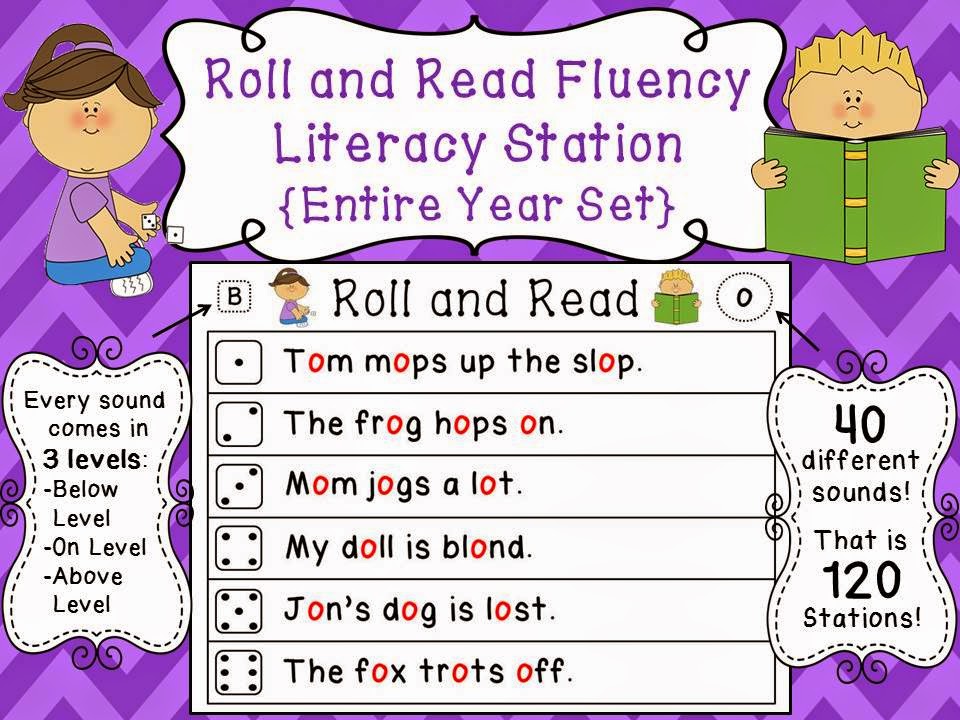
In my
Roll and Read Word Families Literacy Stations set seen above, I have the word family in "helper red" to help it stand out to the reader. Having the focus sound be in another color will help the reader chunk "at" together when reading instead of having to sound out each letter each time. Instead of "c" "a" "t" you will start to hear "c" "at" instead.
Once the student is reading the words quickly and without hesitation, give them the words-only version in all black text. This pack has all words/sentences with both helper red and in all black text for easy differentiation. It will most likely be much faster for them to master this step since they've had so much practice with the word family's words already.
When they can zoom through those words, give them the sentences version of that word family WITH the helper red. I think this is an important step because they see the words they know in context and having the helper red will give them confidence that they know most of the words in the otherwise daunting looking sentences.
The pack comes with 30 different word families and each word family technically comes in 8 different levels:
Level A Words w/ helper red
Level A Words in black text
Level B Words w/ helper red
Level B Words in black text
Level A Sentences w/ helper red
Level A Sentences in black text
Level B Sentences w/ helper red
Level B Sentences in black text
{If you look in the above picture, you can see the level in the top left corner}
Having so many different levels allows you to meet each student right at their level and allows them to work their way up. So important for the little ones who struggle so much with fluency!
If you like this Roll and Read pack, I have 3 different packs in my store. I made them when I first opened my Miss Giraffe store back in the summer of 2013 and they have always been one of my best sellers. I get so much positive feedback on them and how they help students read that completely warms my heart!
{This is the set pictured above}
After your students master the word families, this set focuses on a particular phonics sound. So, instead of focusing on word families, each set of pages focuses on a sound.
The sounds are: short a, short e, short i, short o, short u, ck, all, R blends, S blends, L blends, th, sh, ch, wh, qu, ng, or, ar, er, ir, ur, a_e, i_e, o_e, u_e, -le, y long i, y long e, ee, ea (long), ai, ay, oo (zoo), oo (book), oa, ow (snow), ow (cow), ou, soft g, soft c, igh, ie, and oi/oy.
Each phonics sound has THREE levels instead of 2 to further differentiate but is words only.
This pack is for students who have mastered the short vowel word families!
This pack is the sentence version of the above pack. Each phonics sound (same sounds as the previous pack) has 3 levels of sentences in both full black and helper red just like the other packs.
I actually recently bundled these in a huge pack of over 780 pages of fluency practice found {
HERE} as well if you want all of them.
Like I said, though, focus on word families until they are mastered. Word families can be A LOT of fun to practice! Definitely incorporate pictures to help students visualize the words they're reading as well. "Secret Word" is always one of my favorite activities:
Grab this
FREE here:
Secret Word CVC Short A Word Families!!
For this activity, students look at the picture and build the word. When they have built the first 3 words, they have to unscramble their remaining letters to figure out the secret word.
As you can see here, the secret word is hat. So they glue it on, draw a hat in the empty picture box, and write the word. Kids love being word detectives and figuring out the secret word!
If you want more, you can also get sheets like this for all of the short vowel word families
HERE or for all of the phonics sounds
HERE.
TIP #2:
Reread the same text until mastery: Of course you want a variety of text but rereading the same text over and over for mastery is a great way to build fluency. The more times they read a passage, they better and faster they will get.
Here is the way I recommend doing it...
1) Grab a reading passage at the student's level.
This passage is from my
Kindergarten Reading Fluency and Comprehension Passages but you could do this with any reading comprehension passage!
2) Give students a timer and have them cold read the passage.
I grabbed these awesome TWO MINUTE timers for only $1 each at The Dollar Tree in a few different colors. I love that they are 2 minutes because, well, it's double the reading practice of a minute timer AND it allows those that really struggle the opportunity to read a lot farther. You don't want to give them a 1 minute timer and have them only get through the first line. That's a confidence killer. It's also a great way to differentiate! If you want to use the same passage for all of your kids, give your low kids the 2 minute timer and your high kids a 1 minute timer. They look exactly the same so they won't be able to know the difference. In fact, you might not be able to either so I suggest buying all blue 1 minute timers and all green 2 minute timers (or whatever colors) so you quickly know which is which.
When their timer has run out, have them put some type of symbol to show that is where they stopped. For example, a little heart, a star, ], ), *, whatever right after the last word they read. They could also just put a 1 and circle it signifying it's the first time they read it. I recommend always having the same symbol for the first time, second time, third time, etc. so if/when you quick-check them, you can tell exactly what happened.
3) Have students read the passage
at their own pace (no timer!) and highlight the words with the word family the passage is focusing on as they read.
{Note: If the passages are focusing on phonics sounds rather than word families, like in my
First Grade Reading Fluency and Comprehension Passages, have them highlight the words with that sound. For example, for a CH passage, they would highlight "chat" and "bench" in "We sit on the bench and chat."}
I recommend highlighting the entire word, not just the sound in the word.
Students could also underline (or circle) the words like below:
I personally like highlighting because I think it emphasizes the words best. Students lacking in fine motor skills may also put the line through the word a little at times, obstructing the word and making it hard to read. But it's up to you!
4) After students are done reading and highlighting the focus sound, have them grab their timer again and put their finger on the first word. Ready, set, read! Have them read it as fast as they can until the timer runs out, trying to beat their first read. Since this is the third time they have read it, they most likely will! Be sure to point out to them how rereading really helps them read better and faster. "Wow, reading that again made you such a better reader! Look how many more words you read!" :)
5) Have them read the comprehension questions and choose an answer. Have them reread the filled in sentence to make sure it makes sense.
6) This step is optional but I recommend students read the passage again now that they've focused on the comprehension aspect of reading. Encourage them to read with smoothly and with expression. Remind them to visualize what they're reading as they do. Now that they can read the passage without as much struggle, it can free up some of their brainpower to focus on the meaning rather than just trying to figure out the words.
7) Have student tell you or their partner/person next to them what the story was about.
6) If desired, they can keep timing themselves to see how far they can get.
This is a great activity to do in small groups with the teacher leading. You could give all of the students different passages from the same short vowel sound or have them do the same one.
I also think this is a great center for students to do in partners. Pair up 2 students that are at a similar level and have them do all of these steps together. For timing, have them take turns. One can flip the timer for their partner and follow along with their finger while the other person reads then they switch.
Sneaky little teacher trick: When they're following along, you can have them mouth the words their partner is reading. Model how to mouth the word without using any sound while their partner reads. This will ensure they're truly following along by reading it as well, not just moving their finger after each word.
When they read and highlight, they can do it together so they can help check each other's accuracy. They can also partner read it (read chorally) together after their highlighting if you'd like. The timer adds a sense of competition to beat their time and makes it fun. Encourage students to try to beat themselves (the little mark they made where they left off), not the person next to them.
You can also send these home when they're done with them in class to practice reading at home with their parents.
I also have reading passages like this for the long vowel word families:
TIP #3:
Read sentences adding one word at a time: For students who are really struggling, have them read sentences adding one word at a time.
For example, if the sentence is "The fat cat sat on a mat." the student would say. "The. The fat. The fat cat. The fat cat sat. The fat cat sat on. The fat cat sat on a. The fat cat sat on a mat."
It may seem repetitive but there are many kids that need that. It's a great way to build fluency.
TIP #4:
Put reading practice everywhere!: It seems obvious but students should be reading all day. When starting the new activity, read the directions together. (If the paper/activity doesn't have written directions or they aren't decodable, write student-friendly directions on the board in 1-3 short sentences.) First, give students a moment to read the directions quietly to themselves. Then, have the whole class read it together. Some of your kids won't need the first step but it allows your lower kids the opportunity to sound out words they may not know so they'll be more confident when you read it together. Include short sentence directions with decodable words in as many places as you can.
Write little notes to your students. They will LOVE it and do their best to figure out what you're saying to them. It only takes a second to jot down a positive little note like, "You are doing great in math! Great adding!" on a sticky note and put it on their desk while they're working. Plus it is great for classroom management! They see you put a sticky on
someone else's desk and all of a sudden you have the hardest little workers ever.
You know what students also love doing but is usually considered against the rules? Writing notes to each other! Have scratch paper available that students who finish early can use to write notes back and forth to each other.
But they're wasting instructional time, you may say. I say they're not only writing sentences and reading sentences but they're motivated to do so and having fun while doing it. Teach them how to write a question and how to respond to a question. Set some ground rules, though - they have to use their best writing, write in complete sentences, each person can only write 1-2 sentences at a time, that you are allowed to look at the note at any time to make sure it's appropriate, etc.
Label EVERYTHING. The dollar store sells cute individual word strips (like sentence strips) that are pre-laminated and in fun colors. Write "desk" on it, cut off the excess strip, and tape it on your desk. Repeat for as many things around the classroom as you can (door, number line, desk, counter, cabinet, sink, etc.). You can also use sentence strips to label things in sentences instead: "This is the teacher's desk."
For centers, include student-friendly directions sheets. Not only will this save you soo much time in describing what to do for students because they will be able to be more independent, it provides more reading practice. For example, here is a sample directions page from one of my
math units:
They're quick and easy to make for any activity. They don't have to be beautiful. Students just have to be able to read them. You can even write them by hand. It's just another way to squeeze in a little reading AND build independence. When writing student directions:
- Use short, concise sentences.
- Break the sentences up with spaces between so it's not overwhelming.
- Use pictures/examples if you need to like above to explain.
- Only use words that students can sound out or have sight words that they know or can figure out.
TIP #5:
Sight Word Mastery: We all know this will help build fluency! Make sure parents know what sight words you're working on each week and practice at home. The more sight words students know with immediate recognition, the more fluent they'll be. There are SOO many fun ways to practice sight words but that is a whole other blog post... or 10!
I did write a
blog post I wrote about my
Secret Sight Words activity though if you need some fun sight word practice!
There are A LOT of wonderful sight word activities out there. A simple search on TpT or pinterest can help you there :)
I also wrote a blog post showing another one of my favorite Sight Word activities using bottle caps but I actually showed a lot of picture examples of using them with alphabet magnet letters! I shared a lot of fun ways I use the Sight Word Sentence cards to introduce and practice sight words in that post - you can check it out here:
Sight Words Sentence Cards Fun Ideas and Centers
TIP #6:
Read MORE: Yes, yes, I know. This is beyond obvious. But you may not realize all the opportunities you're missing!
Do you read stories out loud in class whole group? Do you call on one student at a time to read? Get in so much more practice by having students read in groups instead! "Next page, table 1" As the students at table 1 read, listen for any students who may be struggling more than the others. Call on 2 students from that table who you'd like to have more practice read the page again. They won't know you're calling on them because they need more practice.. they'll just think they happened to be picked again. Even if just one student at that table struggled, do it in partners. Reading shouldn't be stressful. Try to pick a partner who is similar in level so they stay together easier. Encourage students to read together and never go ahead of one another. Not only will your struggling students have more confidence because they're reading it a 2nd time, but reading with a partner will lessen the anxiety for that reader to read out loud in class. But since it is only one person they're reading with, they'll have to put in the work to decode and not be able to just seem like they're reading. Watch out for those reading chameleons who are so good at pretending to read!
Many people reread the same story - I think you should also reread the same page! After you did what I described with table 1, you could say something like, "Table 2, I'd love to hear you guys try that page! Can you read it smoother?" Make sure it's a kind competitive spirit.. a little 'competition' can be really motivating for reluctant readers or your really high kids that tend to check out during whole group activities.
You can also say, "Table 3... read that page as s-l-o-o-o-o-o-w-l-y as you can" "Table 5... read this page in your prettiest princess voice" "Table 1... can you read this page in a scary monster voice?" Make it fun!
Mix things up so students never know when they'll get called by calling by a lot of different attributes. Just some examples to call by:
- Tables (Table 1, Table 2, Red Table, Blue Table)
- Girls/Boys
- If you're wearing a red shirt
- If you have a dog
- If you're 6 years old
- If you were born in March
- If your name starts with a A, B, C, or D
- If your hair is brown
- If you can swim
- If you like basketball
... whatever! We all know how much little kids like to tell you all about their lives and this gives them a non-instructional-time-wasting opportunity to give you little snippets :)
- "Do you like dogs or cats? Don't tell me yet! If you like cats more, read the sentence. Ready, go. {They read} Next sentence, dog fans!"
If you can, try to do it by things you can verify like the color of their shirt vs. if they like dogs so you know those who are supposed to be reading actually are but it's still fun to mix in other things anyway.
This may mean that someone has to read a page twice or even three times in a row. That's okay, more reading practice for them. Strategically pick your fun categories when possible. Hmm, I noticed little Sally and little Billy both struggled with that last page we read and they're both wearing blue shirts, perfect! "Your turn, blue shirts!"
Anything to make it a little more fun!
After you read the whole story together, tell all your students to go back to the beginning of the story and put their finger on the first word. Set a timer for a certain amount of minutes and say, "On your marks, get set, go!!" and have them read the whole story from front to back as fast as they can. This is a GREAT way to build fluency, as well as stamina. Walk around to make sure they're not skipping words. This is easy to prevent, though, let them know that if they're caught skipping words, they have to start over. Again, encourage them to beat THEMSELVES, not the people next to them. Give them a small sticky note or a tab and have them put it on the word they stopped on. Repeat the timer for the same amount of time and have them try to beat their tab. They'll think it's a game... Just imagine all the extra reading practice! It takes up hardly any more time after reading the story and gets in a lot of reading!
TIP #7:
Model fluent reading for your students: Make sure you're reading high interest picture books aloud to your students and modeling good reading! Show expression and enthusiasm. Kids love being read to and it's so beneficial for them so make sure you are doing it every day! It's easy to forget with everything teachers have going on but try to work it into your daily routine.
Listening centers are also great for this! There are a lot of great books on CDs they can follow along in as they listen to.
You can also do little super-mini lessons when your students are reading too ro-bot-ic-al-ly by saying, "Listen to me read this." and read the sentence all chunky like a robot. Then read it smoothly and with expression the way you'd like them to. Ask them which sounds better.
TIP #8:
Have students memorize the different phonics sounds: This is SO, SO important and why all of my
literacy stations focus on phonics sounds. I always have each page focus on a different phonics sounds (usually found in the corner). I think it is SO, SO important for students to know the phonics sounds (digraphs, vowel pairs, diphthongs, etc.) so they can decode anything they come across!
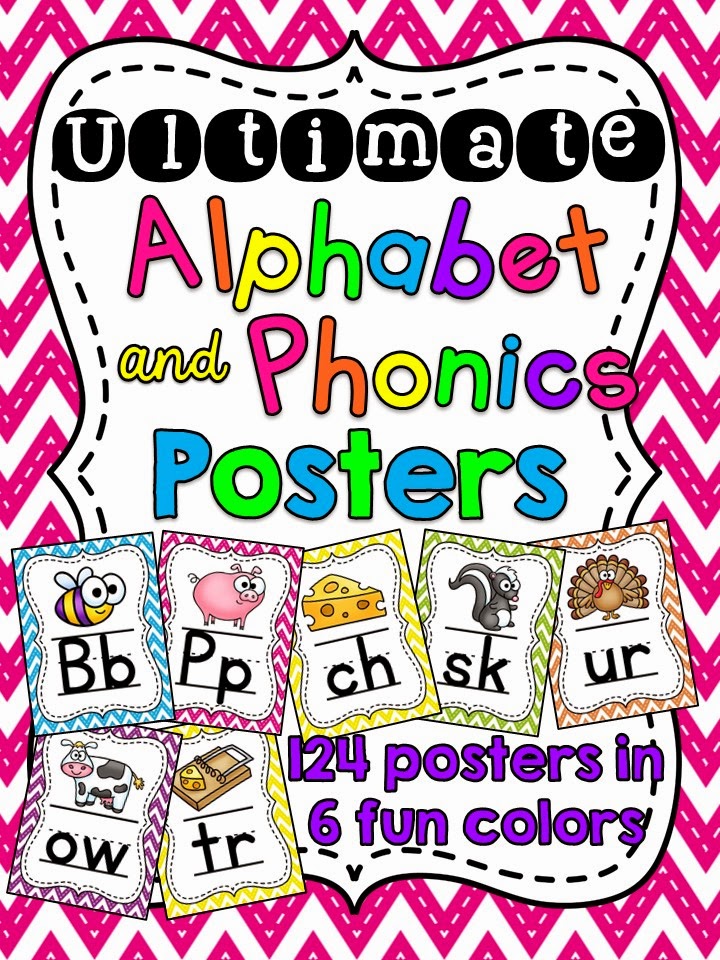
Be sure to display the sounds around the room. If you need posters, I have some available:
I also cannot recommend enough having students keep a
sounds reference chart at their desk and at your small groups table of the different phonics sounds with a visual reminder so they can have it right in front of them.
My
Sounds and Blends Charts have been one of my most popular items and I have about a million copies of them laying around :) They are so useful!
If a student is having trouble sounding out sharp, for example, have them find the chunks on their sounds and blends sheet. They'd find the SH with a picture of a shark and the AR with a picture of a star. All they'd have left is the P :)
Make
phonics sounds flash cards! These are super quick to make. You can do this on large paper (regular sized paper and write it with a thick marker) and hold them up yourself... OR, if you have an interactive whiteboard, make a simple powerpoint. Use a kid-friendly font and put one sound (CH) in giant letters per slide for the sounds you want to practice.
- You could just have your students say it as soon as they see it but your higher kids will say it way quicker than your lower students figure it out. This can be okay if you all look at it and say it together once it's been identified but I personally think there should be think time first.
-
What I recommend is showing the slide and have students put their hands together in front of them (palms touching) or some other subtle signal to let you know they know the answer that doesn't disturb others and keeps their hands busy. This will allow your kids who always want to be the fastest the opportunity to get the satisfaction of showing you how fast they know it (so you can give them the approving
well aren't you so smart smile) without blurting it out. If they don't blurt it out, this gives your other kids the opportunity to figure it out themselves. Plus, it keeps their little roaming hands busy and to themselves :)
- Once the majority of your kids have their hands together, have them say it quietly to their partner. You could have the kids on the left tell the right (alternate) to make sure both kids are contributing or just have them tell each other at the same time which I think is fine as well.
- Call on a student for the answer.
- Once you go through all of the sounds this way (it can go really quick once they get the hang of it!) at least once, do the speedy flash card way of just going through the slide as they yell it out to quickly review. Don't forget to tell them how smart and wonderful they are :) I know, I know, I'm queasy but I think school is a lot of work for little ones and they need a lot of positive reinforcement. Heck, I like positive reinforcement. Please tell me how well I organized my closet (ha!) or how nice it was for me to attempt to cook a dinner for my husband even though I may have set off the smoke alarm. But really, everyone likes compliments! Learning should be positive always.
If you want to see MY phonics work, centers, and activities I do, check out these huge posts full of pictures and details!
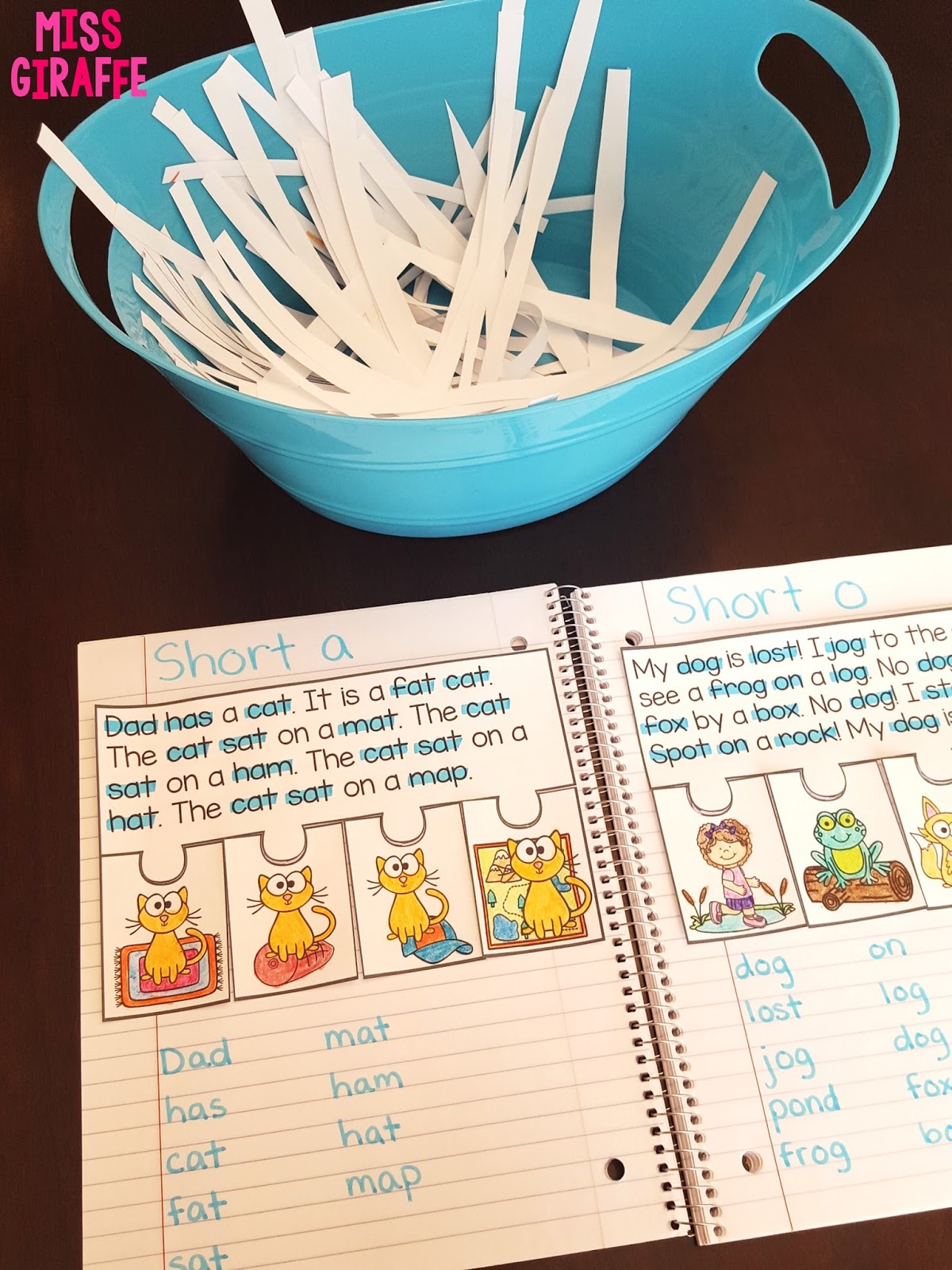
Short A Activities and Ideas
Digraphs Activities and Ideas
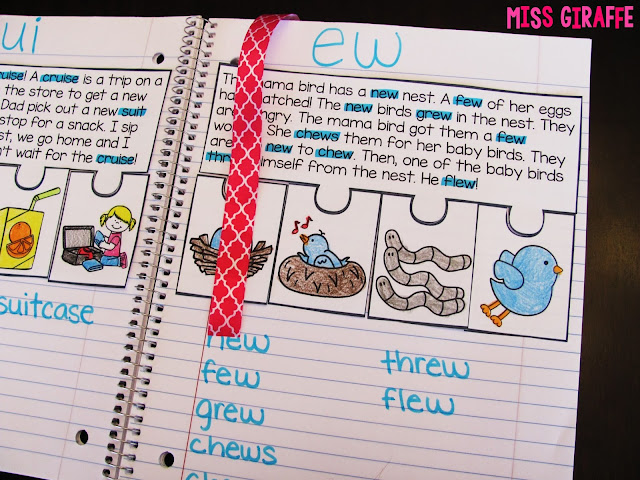
EW UE UI Activities and Ideas
The posts focus on particular phonics sounds but the ideas and activities can be used with any sound!
TIP #9:
Incorporate song lyrics: Do you have songs you sing in class? Maybe you sing math songs during calendar time... maybe you sing songs during clean up time... maybe your school has a school song you sing... maybe you sing lining up songs... maybe your students just love a particular song that a snowy princess looking for her sister sings {that has been stuck in my head for MONTHS}...
Write the lyrics out on a sheet of butcher paper or on a giant notepad. Point to each word as you sing the song. Hang them in the classroom in an available place so students can use pointers (love pointers!!) to point to the words as they sing it during free time. I know you may not be able to give a lot of free time because of the pressure of how much you have to teach your littles but play can be SO beneficial. Have a lot of things around the room students can read and "play teacher" with when they get the opportunity.
TIP #10:
Let them read!!: Let students read when they're done with their work! (Until everyone is done or the activity time is over.) It's as simple as that!
Although I love the idea of pre-selecting books that are at their level for them to read and putting it in their own little box of books to choose from, I think they should also get opportunities to read any book from the library that they're interested in. Cultivating a LOVE of reading is just as important as learning to read, in my humble opinion :) I think students should read leveled books during literacy centers time but any time they are done with work any other time, let them pick the books they're interested in! They may occasionally get books that are too hard for them because they're fun read aloud books they've heard in class before but isn't that okay sometimes if it makes them so happy and look up close at a book they love?
I suggest making a rule that there can only be 2 (or however many you think) kids in the library at a time to SELECT a book and that they cannot talk while at the library. They select a book, go back to their desks, and read quietly (but aloud!) to themselves. If they realize the book is too hard/easy for them or they're done with it, they can put it back where they found it and select a new book.
I heard a GENIUS idea to give each student a hard bookmark type thing with their name on it that is slightly taller than the books to have students put it exactly where they got the book from (put it between the books the book was between). So, when they go to put their book back, they'll put it in exactly the right place! AND you'll know if you have a book hoarder who has 5 books in their desk... or if a book is missing... ensure they only get 1 book... etc. :) It helps soo much with organization! Especially if you're crazy like me and organize everything by category.
My favorite suggestion is to have a time dedicated just to reading. Let students each pick 2 books to take somewhere in the classroom and just read. They can lay down however they want to wherever they want to, cozy up, and read! You'll have kiddos in corners, on the carpet, on their backs, on their sides, on their heads.. well, maybe not on their heads (that'd be impressive!) but they'll be everywhere. Of course, they have to be more than a leg's length away from any friends. They'll love it!
The more they read, the more fluent they'll get!
TIP #11:
Students should always be reading OUT LOUD: Yes, it makes the room a little louder but it's worth it! Teach them how to whisper read. They'll be quiet enough to not disturb others but you'll know they're actually reading and can listen in if you need to. If they're "reading in their heads", they might skip words or even just be pretending to read and looking at the pictures.
Listening to reading helps build fluency, including listening to themselves!
I hope these tips have helped you at least a little and I don't sound like miss bossy pants or super disorganized in my thoughts. I didn't map this post out before writing it and I do tend to ramble! :) But hopefully you found a tip that will help you help your students build their fluency!
How do you build fluency in your students?? Any tips you'd like to share?
If you want to keep up with all the teaching ideas and fun stuff I share, you can follow me in these places:
You can also check out all my favorite blog posts I've written organized by topic here:
Also - don't forget to join Miss Giraffe's Class so you never miss out on fun ideas and exclusive free stuff from me only for subscribers!
Here's a picture for you to pin if you want to save this to read again later! :)